Tired
Life has fallen into a bit of a rut recently, and I’m tired.
I’m in Birmingham still, still at home with my parents, still unemployed and looking for work. Still broke.
Each day I drift into conciousness, drag myself out of bed, drink tons of coffee and try to motivate myself to apply for work. Look at the RSS feeds, see what’s advertised. Try and select what looks possible from the impossible and the improbable. Fire off CV’s (that’s Résumé’s for you in the states), fill out applications forms. Send them off, hear nothing back.

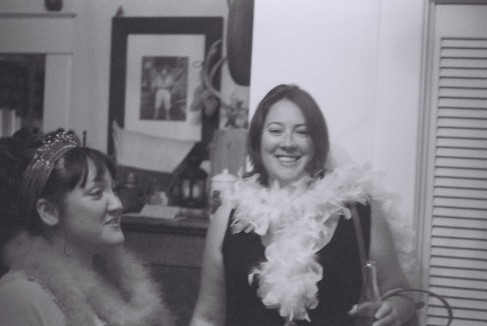
Three of the beautiful people I had the privilege of visiting at the Manor House (Photo credit: Kari Rosenfeld)
That’s the pattern, with very few interruptions. I’ve become a tortoise, retreated into my shell, only coming out to do what I need to do, then escaping away again, into bad TV, trashy movies and Wimbledon. I know few people here, and I’ve made no effort to see them. All my limited energy is focused on what I need to do to get onto the next step. A step that never comes.
Still, there are some things to take delight in. The sunshine. My parents garden, a genuine oasis in the city. Letters, CD’s, emails and skype calls from dear friends across the water. A trip down to the manor a couple of weeks ago; a friends wedding in Norfolk this last weekend. Phone calls to good friends. All these things are good, refreshing; but the day-by-day remains the same, monotonous, insular slog – and thus far there seems to be little to show movement on the horizon; little hope of change.
Change will come. There will be a job, and income, and a roof over my head of my own choosing. Eventually. But in the meantime, I’m tired.
One day at a time, huh?
Communication Issues
I have been thinking about communication quite a lot over the last few weeks. I guess it has been one of the major themes of my life, in its current phase. There are the Comms-related jobs I am applying for. The letters, emails, FB-chat and skype conversations and miscommunications with various friends across the Atlantic. And the complete lack of communication with my wife, as we enter the legal process, out only contact mediated through lawyer-friends and official communiqués… Oh, and the wonderful Phil Jackson has left Facebook, and left the rest of us with lots of difficult questions in the process.
All of these different things leave me wondering about the very nature of human communication. We have changed so much, as a species, since the days when all our interaction was face-to-face. Not since the invention of paper has it been necessary to be in the same room as the person we are interacting with, yet I wonder if psychologically we have caught up with the fact, especially as the wonderful world of electronics is constantly pushing the boundaries of what it means to communicate – and maybe even what it means to be human.
I can now ‘chat’ or speak to a friend in America, or Australia, or Hong Kong, in real time. Suddenly, at the press of a button, the thousands of miles between us shrink to almost nothing, and we converse. We can speak (or type) almost as if we were in the same room, sitting close to one another. And yet we are not in the same room, and our interaction, however easy and ‘natural’ is mediated by the medium we are using; it is changed and altered by it, however subtly.
A skype conversation yesterday afternoon, with a wonderful, beautiful friend is a good example. We talked, we looked at each other, we laughed when the other laughed. But there was delay, there was (very irritating) static and interference, and however slight these affects were they were real, and they were accompanied by the knowledge that there was something very artificial in the interaction. We did not talk as freely and as easily as we would had we been in the same room. The natural silences and lapses in our conversation were somehow more pronounced, more awkward than they would have been in person. We were communicating, face-to-face, but it was not the same, as not as genuine as it has been in the past, when we have had the privilege to be in the same room.
The same, and other different issues exist with other mediums. I use Facebook chat a lot, to quickly message friends, and to have long conversations with Americans. I love it – there is a strange connection even with seeing a green dot next to someone’s name; here you both are, online at the same instant, only a click away from interacting. Yet even when in the middle of deep conversation via chat, there is a huge difference from real conversation. There is no real emotion conveyed. We are never fully present to each other – it is so easy to walk away, come back, be listening to music, watching TV, browsing the net, all while engaging in conversation, and all without the other person knowing. You can also be engaging in three or four such conversations at once, which would be completely impossible in person.
Even email, which of all our electronic communiqués is the most similar to a more traditional medium – that of the letter, has its issues and subtle affects. Email has, in fact, been the biggest trouble to me, as I have tried to communicate complex emotions to one particular American friend. Unlike a letter email is so instant; it is far too easy to write something and fire it off without enough (or any) thought. I don’t think there has been a single email to this particular friend that I haven’t re-read after sending and regretted some part of, and that is despite many of them being drafted several times. There is something about the medium that means the care, time and forethought of a letter are just not possible: emails are too quick to write and too easy to send.
The father of media theory, Marshal McLuhan, famously said that “the medium is the message”. Basically, the very nature of what we intend to communicate to someone is altered, often fundamentally, by the medium we use to do so. For example, proposing to someone over YouTube is very different to doing so in a single romantic moment alone with the person you love. The intention on the proposer might be the same, but what is conveyed is fundamentally altered – the video conveys the proposal, but also the proposer’s desire for recognition and approval. The words may be identical, but the message is changed.
So, our communication is changed, what we say by the way we say it. These electronic forms are different from being in the same room, having a one-to-one, even if we don’t always appreciate by how much. Phil, in one of his many statements about the nature and affects of Facebook, has even said that Facebook “denies the limits of human form” (an by extension, all electronic communications): it removes the boundaries of time and space from the way we interact with each other.
And yet, I wonder…
My first thought, on reading Phil’s thoughts about human form, were as follows:
“Have we surpassed our physical limitations? We are no longer one person, limited by a pinpoint of temporal and geographic nature, we have electronically surpassed these constraints, to move beyond… we have Evolved(?)”
As human beings, there are several things that make us different from other animals. One of which is that we have always been, to some extent, ‘fuzzy’ from a temporal point of view. We are not fixed completely in the present, the ‘now’, but are able to stretch our conscience back into the past, and project somewhat into the future. There is, as Ecclesiastes puts it, “…eternity in the hearts of men”: we can contemplate our birth and our death; know the changing of the seasons; learn from the mistakes of ourselves and others; predict outcomes of events; ponder on the nature of the universe.
Yet now, we can extend ourselves far beyond even that. We can be ‘present’ in a room in America and a street in London at the same moment, as we talk on a mobile: our consciousness is simultaneously in both places. We can converse, however partially, across vast distances, across time zones. Is this an extension of our existing nature? Or have we changed?
The fact is that, however much I know the limits of these different media, however much I regret the way that skype ‘awkwardises’ my conversations, email trivialises my missives and Facebook turns me into a voyeur, these are the only ways I have of communicating with distant friends. Without these imperfect vessels, I would have no contact with dear friends, because it is impossible for us to sit in the same room and talk face-to-face (Oh! If only wishing made it so!). And some how, even knowing the changes, the limitations, imperfect human communication is far more valuable to me than no communication at all.
Our human nature has changed, as our society has changed. We are spread out. Uprooted. Flung to the four winds. No longer to we grow up, live, work and die within a single community. Many of us no longer know our childhood friends, no longer live (or have any intention of living) in the communities of our upbringing. We have changed, perhaps even we have evolved, and these electronic media become the extensions of our humanity that enable us to connect with those we chose to love. They are imperfect, fragile, broken, as everything we touch is. But they are what we have.
My love to those I know and care for, whatever part of the world you are in.
Ministry
I was talking to a friend yesterday who is slowly making there way through the application process to train for the Anglican ministry. I have been very supportive to this friend over the last sixth months or so, encouraging and cajoling them through the various steps of the process. The friend raised the question yesterday as to why I was being so supportive to someone wanting to become a vicar, when I am so uncertain about the existence of god, never mind the truth and validity of the Christian faith?
It’s an interesting question. I mean, leaving aside the fact that I think my friend would make a good vicar, why be supportive of someone trying to dedicate their life to something which I doubt the fundamental basis of? Is that inconsistent? Or even intellectually bankrupt?
I can excuse myself somewhat on the fact that I doubt, rather than disbelieve. I freely admit that I don’t know what the truth is, so how can I say that someone is doing something wrong? But then, as my friend pointed out, I am not standing impartially on the sidelines, but metaphorically at least cheering them on. How can I justify being supportive of this career choice?
I don’t really have much of an answer for this, at least not necessarily a satisfying one. On the one hand I can admit that, despite my doubts, Christianity could be true. If it has the possibility of truth, then why not let people dedicate their lives to that possibility, if they themselves are convinced? I think I can also see a benefit to the church, even if the underlying assumptions are false: faith provides a solace for many a hurting soul, and Christian ministers are often (but by no means always) some of the most selfless and caring people in our society. If a friend wants to support the hurting and downtrodden in our society, why not encourage that?
I know that some people who reject the premises of faith believe that ministers are liars and deliberate deceivers, who are actively misleading their congregants by peddling a false doctrine. I don’t think that I could claim that, even if I became convinced that the Christian faith was untrue. I have met too many Christian leaders, and most of them are very sincere in their commitment to the gospel. They believe it is true and live their life by that belief. I think that is honourable.
That is not to say that there aren’t bad apples. Being a paid minister of a congregation is a position of power and influence, and I am convinced that some people in those roles are more interested in that personal influence than they are in ideas of service or truth. Some expressions of ‘Christian’ leadership are manipulative, self-serving and damaging. But I don’t in any means believe that is true for the majority, or that the roles in themselves are negative. Too many people use those positions to serve their parishioners, to play genuinely caring and comforting roles.
I don’t know if Christianity is true. There is much that I question. But it could be true, and if it is that truth is important. And even if it is not, it is a doctrine that inspires a lot of charity in its adherents, so why shouldn’t people who are seeking to go into ministry for the right reasons be encouraged? Especially if you think they’d be good at it?
What do you think? Is this an intellectually bankrupt position? Should I refrain from supporting my friend until I’ve thought this faith thing through some more? Or is this just a throwback to my previous years of faith?
A Sense of Injustice
One of the features of being in a place of doubt, is that while there are things that I find make it hard for me to believe in the existence of god, there are other things that I find equally hard to rationalise away. Some of these things are harder to define, somewhat more esoteric, perhaps, than specific doctrines, but that doesn’t mean it isn’t worth trying to elucidate them a little.
Somewhat related to the last post is the problem of our sense of injustice. As I said in the last post, it seems that a natural and somewhat universal human response to tragedy is to shake our fists at the heavens and shout “WHY?!” We experience a profound sense of injustice to situations of death, sickness and suffering – as if deep down within us somewhere we believe these situations to be fundamentally wrong. The question I have though, is why is this true? Why is this the most common human reaction to tragedy?
If you look at the question in Theistic terms (believing in the existence of god), then it is relatively easy to explain. Either, as discussed in the last post, the tragedy is caused or ‘ordained’ by the deity – in which case there is someone/something to be genuinely angry with. Or it is caused by the consequences of evil or sin in the world – in which case, there is again a force to be angry with, or else a right sense that the world was not meant to be this way, and therefore the situation is genuinely wrong.
It is more difficult trying to explain this sense of injustice from an atheistic (belief that there is no god) standpoint. In fact, I’m struggling now even to frame an argument for this side.
What purpose does a sense of injustice towards tragedy and dire circumstances serve? Does it somehow help us heal from the pain, to be able to have something to blame? Does having an outside cause stop us feeling so tiny, powerless and insignificant in the face of the vastness and complexity of the universe, and hence stop us going insane?
You could perhaps argue that a sense of injustice is simply an inherited characteristic from our more ignorant, superstitious pasts. But that doesn’t help much, because you then have to ask why such a superstition would evolve in the first place? What purpose does it serve? And why is it that, even the most committed atheists and agnostics seem to fall back to pain and anger in the face of personal suffering?
I guess my question is this: is it possible that a sense of injustice is inbuilt, inherent in all of humankind? And if so, how do we explain the existence of this response? It isn’t simply biological, because it isn’t something we see reflected in the animal kingdom – even the most ‘emotional’ animals grieve, and then get up and get on with their lives – they seem more able to accept death than humans are.
Humans are dumbfounded and full of rage and injustice in the face of death – as if we were never meant to die. A Christian will tell you that this is because we never were meant to die. But what explanation can the atheist give? The best I can come up with is that this is an inherited response from a more superstitious age, intended to protect us somehow from… and then I get lost.
In and of itself, this isn’t compelling enough to justify a theistic position for me. But there are other parts of our humanness that I can’t easily explain in evolutionary terms. Hopefully I’ll get on to those here in time.
Sovereign Gold?
[Warning: this is a long post, and a bit of a rant. I get a little heated here; sorry]
As I said in the last post, I find it hard to know exactly what I believe about god and about Christianity right now. But I think there are some things that I can safely say that I don’t believe. Or, at least, are things that prejudice me against the Christian faith, if they can be described as indicative of that faith.
One of the things I realised at l’Abri was quite how angry I was towards certain Christian theologies. There are beliefs within some wings of the church that I find downright insidious and damaging. Some of the ones I find hardest are those held by the Reformed or Calvinist branches of Christian faith.
Now, a friend complimented me last night on how I had managed to write the last post with a ‘profound lack of bitterness’ in my tone. I want to apologise right now if I don’t manage to maintain that attitude here. I am going to try and be charitable, but I don’t honestly know if I will manage it.
One of the biggest issues I have is with the concept of the Sovereignty of God. The idea, as far as I understand it, goes like this: God, if he exists, has to be the biggest, most powerful being conceivable. God created the universe out of his will, and sustains it out of his will. The very continued existence of the universe is because of the present, continuous will of God. But more than that, God, being the biggest, most powerful force in all of creation, is fully sovereign over all of said creation.
Which is taken to mean, in this theological interpretation, that everything that happens, happens according to the will of God. Effectively, ‘because He Said So‘.
In some ways, this is one of the oldest philosophies. The Greeks and the Persians, and all sorts of ancient peoples would look upon a natural disaster, such as the failure of a harvest, an earthquake or a volcanic eruption as the anger of the gods. The Mayan’s would sacrifice people to appease the wrath of the gods. It is an OLD idea.
And even today, to many of us, it is the first, most natural thought when it comes to the existence of a Supreme Being. When sickness or natural disaster, or unnatural calamity afflict us, our deepest hurt reacts, crying WHY?!?
We cry ‘why?’ because we believe there to be someone to blame, someone pulling the strings, someone afflicting us. I find it perfectly natural that reaction in so many of us is to find someone to blame; someone to direct our understandable anger at. I have done the same. I have angrily ranted and blamed God for my hurt and my circumstances in the past.
The problem I have is when you turn the understandable first reaction of a hurting individual into a cast-iron theology, into an explanation of The Way The World Is. This theological understanding of the Sovereignty of God says that everything that happens, good or bad, is the Will of God. Everything. The failure of a harvest, an earthquake, the collapse of the money markets this year, the almost-inevitable victory of Manchester United in this year’s Premiership, the Holocaust.
While it might comfort us in the midst of our pain to shake our fists at God after the death or a friend or relative, to have someone or something to vent at and direct our cries of ‘Why?!’, it doesn’t actually comfort once the blood has stopped boiling. It actually makes the questions harder, deeper. You see, to me, it seems that if you ascribe the cause of every action to God, then you have some real issues when it comes to his nature. A God who causes Holocausts and tsunamis doesn’t seem very nice. I honestly do not know why anyone would want to be involved with, let alone worship, a divine entity that sweeps thousands of unsuspecting individuals away in a ’sovereign’ fit of pique.
We’re hit with a real dilemma here. The Christian god is supposedly described as gracious and compassionate, as the very embodiment and definition of love. Not loving, but love. Yet there are very few circumstances that the average person can imagine where killing someone could be considered loving. And what happens when we consider sickness, or poverty, or oppression, or the evil, damaging actions of individuals?
Now, the proponents of this theology would probably argue that there are also verses in the bible that speak of gods anger, and of the sinfulness of man, and of gods sovereignty. Well, yes, there probably are. I’m not pretending that there is no rational basis for this idea, that it isn’t a theology that someone of good conscience can hold. I know good people who believe this. I wish they wouldn’t, but they do. I don’t love them any less (well, much less) or value them less as human beings for espousing this belief.
But I have huge problems with the idea. Of what it tells people, of what it communicates about the nature of reality, of this supposedly-loving god. I have a friend who was raped. Another two friends who were sexually abused as children. These friends have been profoundly damaged by their experiences, by the evil, deeply wrong actions of human beings. These events overshadow their whole lives. But rather than giving them comfort or solace, this insidious doctrine lays the blame for these crippling events at the feet of god himself. It says that, because God is Sovereign and only the things that He Purposes happen, that in some way these terrible events must have been His Will for my friends lives. God ordaining rape and child abuse? No thanks!
I have a family member who has been sick, bed-bound, for 8 years now. Eight years, their whole adult life, stolen, and that of their parents who care for them too. Does it comfort me, or them, to think that god has planned this, purposed this, even if it is (somehow) supposedly for their good? No. I think that, if this is gods will, then he’s a real sadistic bastard.
(sorry, I think I might have lost my ‘lack of bitterness’ there)
If you think I’m being ridiculous here, or painting a wrong picture, then I just want to repost this link, to a very senior figure in the Reformed wing of the American church, who is effectively saying that God caused a bridge to collapse and kill people. Why? Because we’re all sinners and deserve to die, and this event reminds of the fact. Effectively, we should all fear and tremble before God, and be grateful that He is so ‘loving’ as to let us live our pitiful existences in the first place.
I’m sorry, no. Just no. I don’t know how to resolve the problem of suffering. I don’t know how to square the circle when it comes to the seeming incompatibility of the sovereignty of god and the free will of his creation. But I do know that my friends were abused by human beings, and to shift the blame to god removes comfort rather than gives it. To say that god ‘ordained’ the action somehow is seeking to find purpose in actions that are evil, wrong and damaging – actions that are inherently purposeless. And it removes the blame from those who should carry it, squarely, on their shoulders.
To blame sickness, or natural disasters on god is perhaps understandable in emotional terms, but in theology or philosophy it simply creates a monster of a deity – an angry, vengeful, petulant god, not in any way deserving of love or worship. If god causes tsunamis and earthquakes, if he afflicts people with sickness deliberately, if he purposes, directs and ordains rape, child abuse, murder, then there is nothing loving in him, and I for one don’t want anything to do with him.
Like I said, I really don’t know what I believe when it comes to the existence of god or the problem of suffering. It may be that the cruelty and hardship of this world are all because of the selfish actions of human beings and the natural movements of tectonic plates – that it is all random and senseless. It may be that god exists and weeps for the brokenness of his creation. I don’t know.
But I do know this – there are some doctrines of some parts of the Christian church that paint a picture of a deity that I want nothing to do with. I don’t find them believable, good, or consistent with the idea of a god that is meant to be the very definition of love. I can’t believe they are true, but if they are, I want nothing to do with them.
Reflecting my mood
Him:
So this is how the story went
I met someone by accident
That blew me away
That blew me away
It was in the darkest of my days
When you took my sorrow and you took my pain
And buried them away, you buried them away
And I wish I could lay down beside you
When the day is done
And wake up to your face under the morning sun
But like everything I’ve ever known
I’m sure you’ll go one day
So I’ll spend my whole life hiding my heart away
And I can’t spend my whole life hiding my heart away
Her:
I dropped you off at the train station
And put a kiss on top of your head
I watched you wave
I watched you wave
Then I went on home to my skyscrapers
Neon lights and waiting papers
That I call home
I call it home
And I wish I could lay down beside you
When the day is done
And wake up to your face against the morning sun
But like everything I’ve ever known
I’m sure you’ll go one day
So I’ll spend my whole life hiding my heart away
And I can’t spend my whole life hiding my heart away
Him:
I woke up feeling heavy hearted
I’m going back to where I started
The morning rain
The morning rain
And you know I wish that you were here
But that same old road that brought me here
Is calling me home
Is calling me home
And I wish I could lay down beside you
When the day is done
And wake up to your face against the morning sun
But like everything I’ve ever known
You’ll disappear someday
So I’ll spend my whole life hiding my heart away
And I can’t spend my whole life hiding my heart away
[Brandi Carlile, Hiding my Heart Away, the bonus track to the brilliant album, The Story. The lyrics here aren’t quite right (and the voicing is mine), but they reflect my mood…]
The Dream
I’ve been thinking about what I want for my life, spurred on by the encouragement of various friends and commenters. It’s never been an easy one for me, as I tend to be interested and inspired by many things; distracted by the next dream or possibility… I’m going to think seriously about what I want my life to look like in 5 years time, and I may or may not post on that in time, but for now I want to try and bash out a recurring dream…
My two terms at l’Abri have had a profound affect on me, as I know they have on many others. But the following idea, while added to and flourishing in that environment, has been germinating in me for years. Each new encounter is a new form of inspiration, an new bit of clarity; developing a sense of “like this, but not like that…”
So what’s the dream? Well, I am still trying to pull the hazy distant imaginings into a describable reality, but as far as I can sketch at the moment…
The dream is a farm, run by a community of like-minded individuals, living a shared life together. It aspires to self-sufficiency, and even an abundance, so that the product of the land can be crafted, shared, even sold. It grows organically, perhaps using permaculture principles, but certainly trying to steward the land in as efficient, diverse and environmentally sustainable manor as possible. It aims to have the minimum possible carbon footprint; hopefully even managing to be a negative generator of CO2.
The community is centred on the shared belief of the fundamental creative nature of all of us, and seeks to express that in everything it does. In terms of food production, it aims to take control of as much of the food cycle as possible, and produce in-house food of the best quality, from seed to table. It would seek excellence in all areas, and aspire to creative, wholesome, nutritious and desirable production, for the enjoyment of the farm, the local community, and beyond.
The farm would be an artistic fellowship, seeking to be a place of communal artistic expression, a cradle and crucible of talent. Residents and guests would work part of their time on the land or the products of the land, and part of their time in the pursuit of creative expression. It would be a place of music, of sculpture and painting, of photography and film; a melting-pot of ideas, inspirations and the result of shared artistic endeavour.
The community would aspire to follow the inspiration of the Arts and Crafts Movement; not necessarily in terms of style, but in terms of seeking to produce quality, hand-crafted works, and the high value to aesthetics and the goodness of beauty. Like “Morris & Co.” it would seek to develop craft-based production of beautiful things: hand made furniture, book binding and printing, clothing etc. Perhaps in time it could be a place of fostering new ideas and principles in art, architecture, education etc.
The community would be based around a shared life, in the belief that we are more human when we are not isolated and live in fellowship with other human beings. Or, to quote Christopher McCandless: “Happiness is nothing if it is not shared.” It would seek to work together, eat together, play together and laugh together. There would be a common commitment to a ‘slow life’, to a reducing of the intense, depersonalising, technology-driven nature of our western life. It would, especially, seek to be an alternative to consumerist materialism.
Last, for now, and by no means least, the community would seek to be a place of shelter. The phrase that comes to mind is “freely you have received, now freely give”. It would seek to welcome strangers into its midst, and to be a place of refuge for those that need it, for as long as they need. The community would aspire to growing, not as a hand-picked collection of friends, but as any and all who need to be there, and can commit to the shared values and vision. Inspired by the monastic orders of old, the community would practice salvation through work; that labouring with and for the community can in and of itself be a healing thing.
There is probably much more to write, but that is enough from me for now. This is a rough outline of a steadily growing dream, and it is by no means my exclusive proviso. If this is ever to develop out of the hazy imaginings of my own mind and into an achievable, concrete reality, then it will do so with others, and the perspectives of others will be as valid as mine. So, what do you think? Are there others there for whom this is a shared dream? Does this picture, or parts of it , resonate with you? What would you add, what would you take away?
And, just as importantly, how do we get there?
Decisions, Decisions…
How do you make the big decisions in your life? When you are trying to decide where to live, what job to do, which relationships to pursue, what basis do you use for making those decisions?
If I’m honest, I have never found decision making easy. I have an ability to see all the possibilities and consequences of a course of action, which often leaves me somewhat paralysed, not easily able to weigh the different options. But in times past I would have tried to base all my decisions on what seems ‘right’, on what ‘God’ wanted/was saying/was not saying, and on what I believed to be important from previous decisions.
Being in London, being involved with my church there and among the community of friends I had around me, was one of the important markers. I made a lot of decisions, about jobs, about where to live, based on that. I also made a lot of decisions based on my ‘theology’ (for want of a better word), my ideas of what Christian life was meant to look like. All of my career choices since graduating have been about enabling me to continue to live in London, to be involved with my church community there, and work in a ‘Christian’ context, for organisations that I felt were doing important work.
So what’s changed? Well, a lot, honestly. The chaos of the last couple of years of my life has left me questioning pretty much everything, including all the signposts by which I used to make decisions. I am tired of London, frustrated by and somewhat alienated from most of my church, and unsure what, if anything I believe about ‘God’. I am in the process of trying to start afresh; am currently looking for both work and a place to live, and could go and be anywhere… but there are an awful lot of where’s and even more what’s.
I feel somewhat overwhelmed by the possibilities. I don’t know what basis I have for making decisions other than what I want, and I’ve never been that great at working that out. What do I want? I want to live I the country. I want to have space for myself but be involved in community. I want to be near, and involved in the lives of, friends. I want a job where I actually want to go into work in the morning. I want space to see if this writing thing can actually go somewhere. I’d really like a dog…
So that’s something, right? Except, to my structured brain a lot of those things seem almost contradictory. Most of my good friends are in London. In reality, most work probably is too. My experiences of community thus far have been with churches, or with folks from l’Abri, most of whom are now scattered across the globe. If I managed to find a job in a more rural location, I’d most likely be trying to set myself up somewhere where I knew no one, which is not exactly helping with either the friends thing or the community one…
So, what do you do? At the moment, hampered by a lack of cash, crashing with my parents, in all likelihood it will be a matter of the utmost practicality, going for whatever compromise ticks the most boxes. Maybe getting another London job and trying to live near current friends. But that doesn’t satisfy; none of the options I can see in front of me at the moment satisfies. So there is always the possibility that I do something all the more unconventional…
Or just sit here in indecision a while longer…
Consequences
I was watching the film Closer this morning, and it reminded me of this piece. This was also written in the Autumn term at l’Abri, but was never read out, as the subject matter is a little more intense than the usual High Tea fare. It developed out of another piece, around conversations with another writer about the process of recovering from a broken relationship. Again, it is written in a female voice, and was intended to be read aloud.
Just to warn you, that it i not the easiest read…
Consequences
Damn it! I just can’t make sense of it, y’know?! I mean, what the hell happened!
God, this is crazy. I have got to pull myself together; I can’t live like this… It’s been six weeks now. Six weeks! Six weeks of howling and hollerin’ and gnashing of teeth. And tears. Oh, so many tears.
I keep going over it in my head. Replaying those last few days, that last fateful conversation. Where did we go so wrong? I can’t believe I said those things, such hurtful, hateful things. I can’t believe he’s gone.
The bastard! He walked out on me! Four long years of life together and he just gets up and goes!? I can’t believe he would do that? I can’t believe it’s the end…
[*sigh*]
Sometimes I replay those last words, those last shouted and screamed hours together, and I wonder how he could not go. I think I would go, if it was reversed. I think I would have gone, had he not gone first… How can you remain after things like that have been said?
But… four long years! And they were good years, weren’t they? Well, I mean, mostly… We had our fights, but then doesn’t everyone? We weren’t forever in the throws of sexual ecstasy, but is that even possible? They were mostly good; largely good…
[pause]
I have some good memories, looking back. We spent some great times in each other’s company, did some fun and crazy things, and it seems to me that some days colours were brighter and more vivid from being perceived alongside him. I wonder though if that can be true? Weren’t Mondays still Mondays, even back then? The sun still yellow, the sky still blue. But my mind says those days are treasured, and these not, and the absence keenly remembered.
I can remember fights and frolicking, passion and persuasion, jealousy and joy. I look back through clear and hazy rememberings and search for some clue, some explanation. Some indication of where the hell things went wrong. How did hell come out of heaven?
I wanna find a key, a lever, a magic button that if turned, pulled or pressed will return the chaos back into its box. What did we do wrong? What did I do wrong? Did I do wrong? Or was wrong just done unto me?
There are things he said, things he did… *Aaugh*! My blood boils! But there are things I did, things I said… things of which I am deeply ashamed. I desperately wish I could undo some of those things, unsay some of those words. Does that make this my fault? Does that make this hurt self-inflicted?
[pause]
I sit here, and I cry. Or I scream. Or I drink wine until I can’t feel any more. I just can’t get over it; I just can’t.
He. Left. Me. He left me. That’s not my fault! He was the one doing the leaving! How can that be my fault?! How is it that I sit here day and night and scream inside ‘what have I done?!’
I didn’t walk out, I didn’t slam the door, I didn’t leave and not come back. So why do I feel guilty? Why do I berate myself all the goddamn time? Why do I search endlessly for things I could do, or say, or undo to persuade him to return? Why do I want him back so much, when it was him that hurt me?
And if it was my fault, if it was all my fault, then why am I so angry with him? Why does it hurt so?
It can’t be. It can’t be just him. It can’t be just me. But here we are, in this big, smelly shit of a place, and we tried so damn hard! It seems so wrong…
[pause]
How do you deal with the consequences of your actions? How do you even know for sure what those consequences are?
I can deal with the fact that third cup of coffee is going to stop me sleeping. I don’t like the reality of the tossing and turning, but I can appreciate my mistake and take some ownership of it. But this? The messy end of a relationship, where you can’t even be sure you know where the mess starts and the relationship ends. Which consequences, of which actions?
It’s such a big goddamn awful mess, and I just don’t know how to make sense of it all. I know I done him wrong, and I know he wronged me, but does that justify the pain, or the end? I can’t find that lever, no matter how hard I try…
[pause]
The past plays through my mind like a film in a theatre. I watch my actions like I’m seeing some other girl up there; see his from a distance. I’m looking, searching for the turning point, the tipping point, from which hurts easily forgiven become long remembered, from where its all downhill.
I just can’t see it. I see things he did that make me scream; things I did that make me cringe. I see things that make me laugh and smile. But every which way I play it, I can’t see or make sense of when the change comes – when we stopped being lovers, but were enemies in the same bed. It must be there, mustn’t it?
Where did we go wrong?